|
|
|
Robert Capa may be remembered not as a photographer of 5 wars, but as thephotographer of the last wars really touched by American hands. Capa's most memorable images - The Spanish Civil War of the late 30s, D-Day at Omaha Beach in 1944 and the beginning of the Vietnam War-have lasted as documents not only because of their unique place in the social record, but the keenness of an eye willing to examine the human costs of war. Specifically, Capa documented war in Europe, in its streets and pastures, homes and beaches - a sight Americans of my generation and several successive generations will probably not see on our own soil, in our hometowns. Capa has endured through the steadiness of his camera and its compassionate searching.
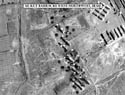
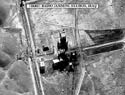
Americans today see war as a video game, sport and spectacle. Media theorist Paul Virilio said of Operation Desert Storm that the "[war] occurred in Kuwait, but it also occurred on the screens of the entire world." Calling Operation Desert Storm the first "live war" (live like a television event), Virilio believes that this televisual world brings about "a de-realization, the accident of the real. It's not one, two, hundreds or thousands of people who are being killed, but the whole reality itself. In a way, everybody is wounded from the wound of the real"(325). The images presented to us by the mainstream media during Desert Storm and its ill-advised successor, Operation Desert Fox, were little more than Defense Department publicity shots. Gun-camera footage places the viewer at the target, but masks the propagandistic presentation of American superiority through technological objectivity and American ingenuity. The DoD images aimed to sell the American people on the calculated, technologically & scientifically precise aggression and to downplay the loss of human life suffered by the Iraqi people and the economic motivations for American aggression in the region. By emphasizing the technological aspects of American forces, the military dehumanized the Iraqi people.
Capa, had he been alive to see such a disgusting display of power and propaganda, may well have reacted like Captain King Kong in Stanley Kubrick's Dr. Strangelove, Or How I Learned To Stop Worrying and Love the Bomb as he rides the bucking bronco of a warhead down to its target. To ride down on a bomb would be his only course of action now, given that their are no more battlefields, per se, but only missiles, smart bombs and television screens. Capa's legendary battlefield tours of duty would be replaced today with a video editing job in a remote corner of the pentagon.
At the time of publication, Capa's battlefield images were shockingly unfamiliar testimony to the horrors of war. These images exist now as anachronisms. Their heroism has long since been replaced with maniacal precision.
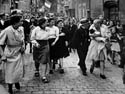
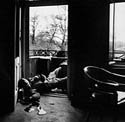
Compare Capa's images from the streets of Hankou, China as Chinese and Japanese planes duel above the crowds and their homes or the American sniper lying dead in a doorway in Berlin to the aerial surveillance photos from the United States Department of Defense. Capa stands on the ground as a man among the people affected by the war. His physical presence on the field of battle puts him on equal footing with the men surrounding him (which does not make his eye exactly impartial then, but definitely more human). The DoD photos show nothing but before and after shots of supposed military installations of the Iraqi Special Republican Guard.
Before: evil regime. After: American triumph and a victory for Democracy.
While one is looking at Capa's works the sounds of people scraping through the debris can almost be heard, the images seem to live to exist not as dry definitions but vivid descriptions of that place and that time. The life of the time and place photographed is rebuilt, realized again through his pictures. What the DoD now offers the American people is equivalent to a late night infomercial - only with less content and honesty up front. At least the infomercials are forthcoming about their motives: you will be happier and more attractive without your baldness, those few extra pounds or your new knife set. What does the DOD offer us but convoluted stories to hide and draw attention away from the suffering of the innocent Iraqi people and the influence of America's economic (primarily oil) interests in the region?
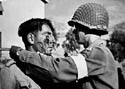
With Capa, every image leaves the causes and the consequences open. He asks us to examine the human role, not the technological aftermath. Even in the bloodiest of his images there is still room for human compassion. From Chartres, France in August of 1944, a woman whose baby was fathered by a German soldier has had her head shaved bare and is escorted through the streets by a policeman and a lurching crowd. The mother holding the child in her arms is receiving the hate of a nation. Capa "transforms her into a Madonna tormented by demons. By pure coincidence (Capa had no interest in painting), that photograph echoes traditional representations of the Massacre of the Innocents. The resemblance, though unconscious, seems perfectly in keeping with Capa's intentions, for his sympathies seem to be with the victim and her baby" (Whelan 13).
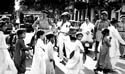
In Hanoi in 1954 Capa grabs another such tenuous moment. One of a group of school girls crossing the street in front of military officials look back with a trepidation that forecasts the weariness and erosion of innocence for not only her young life and the complications of military occupation, but the American image of war before Vietnam. The group of girls all blithely cross the street except for one, who looks back with hesitation. She is tense, she wants the past, she worries about the future. Capa captures this moment of naive ignorance with a surprisingly adept foreshadowing. In the pose of a child in Hanoi we can read an entire tragedy of Vietnam in the years after this image was made.
Capa photographed in Vietnam when it was primarily a French matter, but what was to come both for war and for America are clearly forecast in these last images of his life. He died in Vietnam before seeing the constant attention of television accelerate the public consumption of war's violence on television sets of the late 1960s and early 1970s and the subsequent shift in representation away from photojournalists to the cool and constant coverage of the television camera. It is ironic that Capa's last war could arguably be called photography's last. Television and video started to relieve photography of the burden of truth it had shoulder for most of its short history.
While the horrors of American oppression in Iraq play out courtesy the easy drawl of Tom Brokaw and the Pentagon PR group, the realities of aggression on a national level will continue to be nothing concrete to the American people. As long as the technology dominates not only the act, but the representation of war to America, we will be drawn further and further away from feeling fear, horror or responsibility.
While I was viewing the show at the Terra Museum in Chicago, a group of high school children were being led through the show. All along the way, the children were asked to talk about what they saw and to relate the work on the walls to what they knew about history. In front of Capa's pictures of the Spanish Civil War, the children were asked to assume the role of a soldier in the war. They were writing letters home to their family to describe their experiences. As they children read their letters out loud after 10 or 15 minutes had gone by, I was amazed at not only the narratives they could construct out of the images, but at the fullness of the life described in the letters. One child wrote of all of the people he was fleeing to France with after Franco's victory. Others described the constant presence of death and the gradual acceptance of it. Walking away from the exhibit I was left to wonder what those same children would have written if presented with the images of American strikes on Iraq. What would children know about chemical weapons and Weapons of Mass Destruction? Without a steady diet of government propaganda to work against, what could this group of children write about the before and after images of an Iraqi military complex? The presentation of the American aggressions against Iraq in the 1990s seems as shallow as the demonization of Saddam Hussein that President Bush, and now President Clinton have pushed on the American people.
Capa left us with images that are very rare, images that speak to the real action, the real loss and struggle of the early 20th century and they fight to keep the humanity in the history of that era. He also left no answers. In opposition to the modern war media machine, Capa asks us to question, not to believe, to feel and not to forget.
Whelan, Robert. "Introduction." Robert Capa: Photographs. Aperture Foundation, New York 1996.
Wilson, Louise K. "Cyberwar, God and Television: Interview with Paul Virilio." From Electronic Culture: Technology and Visual Representation, Timothy Druckery, Ed. Aperture Foundation, New York 1996.
also available through its original place of publication, CTHEORY.
|