 The November/December 1997 issue of American Photo states that the Digital Revolution is over. To this I would add that it ended as quickly as it began. Computers and various digital technologies have been integrated into our culture faster than anyone would have imagined. Digital-imaging technology has radically changed the entire realm of traditional, film-based photography. Artists such as MANUAL, Aziz & Cucher, David Byrne and Esther Parada are among some of the many photographers that are now embracing digital technologies in an effort to further realize their artistic goals. This embracing of digital media is also superbly illustrated by the work of Pedro Meyer, one of the foremost straight photographers that now works digitally.
For some twenty-five years, Pedro Meyer has worked as a documentary photographer, allowing us to share in his photographic adventures. Since the 90s, Meyer's work has seen its completion primarily through the computer, which can best be described as a digital darkroom in which he combines the best of both film and digital elements. Through this unison, Meyer creates images of paradoxical beauty that examine the complicated cultures of America and Mexico. His book, Truths & Fictions, is a collection of these images. The book collects work that is redefining what it is to be a documentary photographer in the digital age.
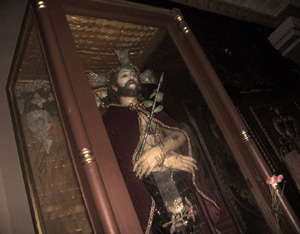
"Ecuador", 1997
Many people, especially photographers, are frightened by the possibilities of digital imaging. There is no doubt that digital imaging has revolutionized how the world uses and thinks about photography, but this isn't necessarily a horrible thing. The debate heard most often is whether digitally manipulated imagery eliminates "truth" within a photograph. This concern is understandable considering that photography has been most commonly used as a recording device since its inception.. What the world will come to realize is that the argument of whether these new images are "true" because they have been "manipulated" is ultimately moot. Many seem to forget that photography has been a manipulated medium since its inception, whether it through cropping, angle of approach, sandwiched negatives, retouching, chemical alterations, or any number of the other secret photography techniques employed for more than 150 years. Images produced by the heralded masters of documentary photography have all been manipulated in some way, from Paul Strand and Dorthea Lange to Robert Frank. The computer opens new and exciting possibilities for documentary photographers, but does not necessarily change the way they work. Meyer feels similarly when he says, "I work like I always did, in the sense of knowing what it is that I have to say about a given subject which is calling my attention. In the past, I would make judgements such as what lens, or film, or camera format, etc., would best be suited for that particular topic. Today I include more tools in that process of decision making."
The computer has allowed Meyer to construct realities that are more truthful to what he remembers than to what may or may not have been there. This approach to his work is evident in Truths & Fictions, in which he examines an America caught up in its idiosyncrasies and contradictions. The piece "Five O'Clock News" shows a house burning to the ground as a news cameraman stands feet from it, transmitting the scene instantaneously to a television in the lawn broadcasting that very scene. This is a wonderful portrayal of America's obsession with tragedy and our need and dependence on television to deal with it and dispense it to us. This allows an entire culture to distance itself from a time and place and view it in a neatly packaged viewing event. In "Emotional Crisis," we are presented with a road falling away in the distance as a train rushes by to the left. On the right side of the road is a sign that says 'Emotional Crisis?' and lists a number one can call, seemingly, for help. This seems to suggest a high-paced, straightforward life, but within the dividing lines of the road exists a subtle deviation as one of the lines curves outward and then in again. This illustrates how easily we can breakdown and fall out of the order, reinforced by the sign asking us if we are having an emotional crisis. No matter how structured and solid the scene or our lives may be, at any minute the smallest thing can bring it all tumbling down around us. It is America's false stability that Meyer is tuned into and illustrates so well.

"The Temptation of an Angel"
In addition to the American work in the book, Meyer also presents work from his native Mexico. In these images, Meyer deals with a modern mythology that is as much a portrayal of reality as it is a fabrication of an imagined scene. There appears to be a much more imaginative appearance to the Mexican work that translates into an almost dreamlike quality. Playing off existing scenes Meyer's images illustrate captivating stories. One such example is "The Temptation of the Angel". We are presented with a girl dressed as an angel. She sits at a small checker patterned table on which a small, older woman approaches her holding a fist of twigs engulfed in flames. The girl looks off to the left, oblivious to the approaching woman. The girl as angel represents a purity and innocence that is reinforced by her young age. The miniature woman suggests a temptation, as if offering the girl the very fires of hell. The girl is oblivious to her approach and thus is vulnerable to the unknown temptation. However, the woman also represents tradition and ritual that the young girl may willingly be avoiding. This is both a cultural statement and a technological one reinforced by the digital completion of the photograph. The angel's off frame gaze suggests a refusal to accept the constraints of the past and a longing to remain pure and young. This dreamlike and narrative quality is exhibited repeatedly in other works such as "The Strolling Saint," "Explosion of Green Chairs," and many others.
--->
